Not many technology companies can say their product went viral because a salmon shot through a tube in slow motion. But that’s part of the origin story of Whooshh, the Seattle-based fisheries technology firm that started with a fruit harvesting machine and ended up redesigning how fish pass through dams.
The company has come a long way since that 2012 video clip racked up millions of views. What began as a proof-of-concept demonstration is now a deployed technology platform operating at dam sites, hatcheries, and rivers across North America. The salmon cannon nickname has stuck in popular culture, but the actual product suite is considerably more sophisticated than a tube and a blower.
How Did a Fruit Harvester Become a Fish Passage System?
The origin matters because it explains the engineering culture at Whooshh. Founder Vincent Bryan III was testing a pneumatic fruit harvester in Washington State when helicopters flying overhead with fish buckets caught his attention. The question he asked was straightforward: if air pressure could move fruit without damaging it, could the same principle work for fish?
The answer, after several years of biology testing, engineering iteration, and field deployment, is yes, but with significant complexity. Fish aren’t uniform in size or shape. They need hydration during transit. They need to enter voluntarily for the system to work at scale. And the passage needs to be fast enough to avoid stress accumulation.
What Does Whooshh Actually Build?
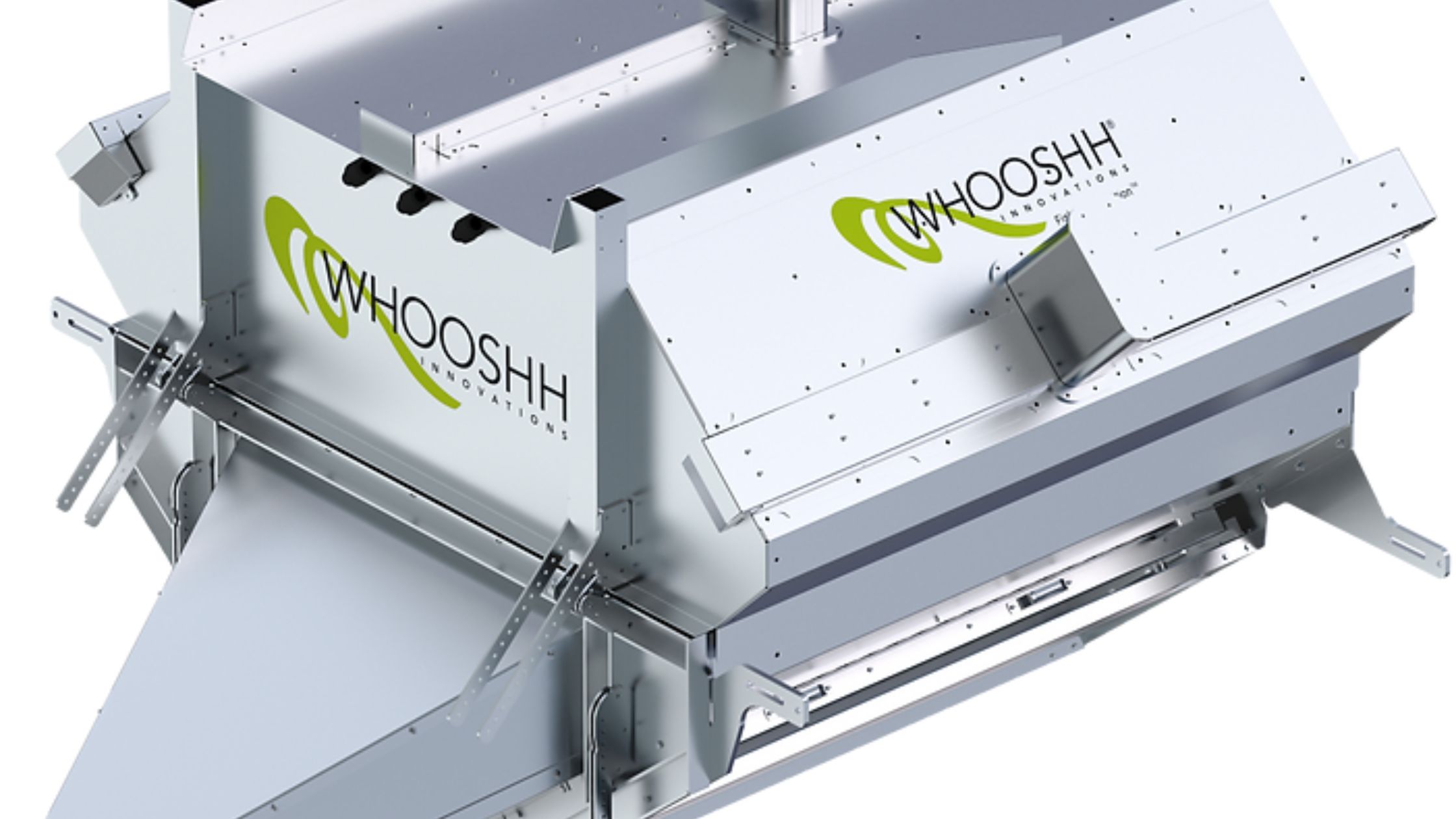
The product line now spans five distinct use cases. For dam-based passage, the PassagePortal systems (Model L for land-based, Model F for floating) handle autonomous, 24/7 fish migration over barriers of any height. For mobile transfer operations, the TUber provides a trailer-mounted pneumatic transport system for hatchery and river trap operations. The Guardian handles invasive species removal. The HarvestSelect serves commercial fishing operations sorting hatchery fish from wild bycatch. And the Selector converts existing fish ladders into selective sorting devices.
Connecting all of these is a core sensing and sorting capability. Here are the key things the FishL Recognition component does across the Whooshh product line:
-
Captures 18 high-definition images per fish from 6 angles simultaneously
-
Classifies species, size, wild versus hatchery origin, injury, and tag presence
-
Delivers classification results in milliseconds without halting fish movement
-
Logs every fish with timestamp, environmental data, and image file
-
Uploads data to cloud or local storage for remote access by authorized users
Why Does the Best Fish Imaging Equipment Matter to Operations?
The best fish imaging equipment doesn’t just generate data for research archives. It drives operational decisions in real time. When the FishL system identifies an invasive species at a passage portal, the GateKeeper sorting gate responds immediately, diverting that fish before it reaches upstream habitat. When a hatchery manager needs to confirm that native bycatch is being released unharmed during a commercial harvest operation, the image record from FishL provides that verification.
At Bonneville Dam, the FishL installation produced over 220,000 fish images from 12 species in a single deployment season. That’s a data volume no manual monitoring program could match, and it was delivered automatically, without additional staffing, and in a format directly usable by the National Marine Fisheries Service.
Is Whooshh Working on the Right Problems?
The honest answer is that it’s hard to look at the current state of freshwater fish populations and argue that more of the same approach will be enough. Wild salmon populations in the Pacific Northwest have been declining for decades despite significant passage and management investment. According to NOAA Fisheries, multiple Pacific salmon populations remain listed as threatened or endangered under the Endangered Species Act.
Whooshh’s approach doesn’t claim to solve all of that. What it does is improve three specific variables that matter to population outcomes: passage efficiency, species selectivity, and data quality. Each of those improvements, applied consistently across a river system, compounds over time.
The full scope of what the Whooshh Innovations platform enables across different fisheries contexts is worth exploring directly. The technology has moved well beyond a viral video. It’s now a working infrastructure choice for operators who take fish passage seriously.