
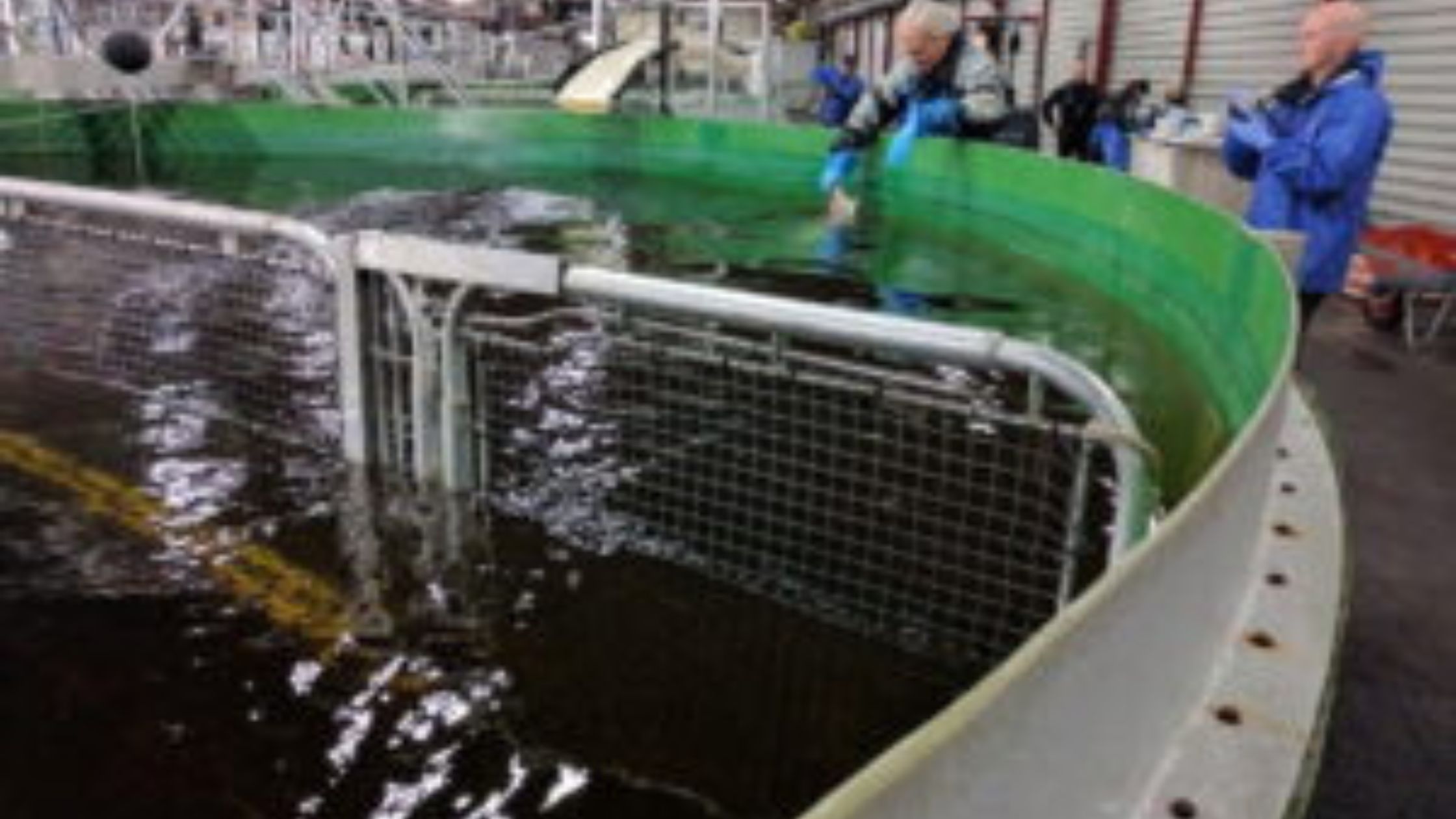
We’ve been working with hatchery operators and aquaculture facilities long enough to know that the biggest inefficiencies in live fish handling are usually the ones that have been in place the longest. Nobody questions the aqua pump anymore. Nobody asks whether carrying fish between tanks by hand is actually the best available approach. These things have been standard practice for so long that they’ve become invisible.
At Whooshh Innovations, we built our fish handling and aquaculture systems specifically to make those invisible costs visible.
The aqua pump has been the default transfer mechanism in hatcheries and RAS facilities for decades. It works. But it requires significant water movement to function effectively, and that water demand creates a cascade of downstream costs: higher energy consumption, more complex waste treatment requirements, larger floor space allocations for plumbing, and greater stress on the fish going through the system.
Fish stress during handling is not just a welfare concern, though it is certainly that. It’s an economic variable. Elevated cortisol levels in hatchery fish are associated with lower survival rates in stock enhancement programs and lower yield quality in RAS systems. A 2016 aquaculture fish welfare study conducted by SINTEF, one of Europe’s leading independent research organizations, assessed Whooshh’s fish transfer technology against conventional methods and found measurably lower stress indicators in fish processed through the pneumatic system.
What Does Hatchery Fish Transfer Look Like Without the Traditional Bottlenecks?
Our SalmonCannon and MigratorTube system replaces the aqua pump with a pneumatic transfer mechanism that requires only a gentle misting of water inside the tube, rather than the high-volume water flow the pump demands. Fish are hand-loaded at the entry point, travel through the tube on a misted cushion of air, and arrive at the destination tank without the stress markers that aqua pump transfer generates.
The operational benefits compound quickly once operators start tracking them. Here’s what our systems consistently deliver in hatchery and RAS contexts:
- Reduced water consumption, with tube transfer requiring only misting rather than full water flow
- Lower energy draw compared to high-volume aqua pump operation
- Reduced floor space requirements by eliminating bulky pump plumbing infrastructure
- Lower maintenance costs from fewer mechanical components in the transfer path
- Reduced fish stress leading to better post-transfer survival and, in RAS contexts, better product quality
- Improved personnel safety by removing the need to carry heavy fish loads manually or work around large pumping systems
How Does This Fit the Specific Needs of RAS Facilities?
Recirculating aquaculture systems are growing as a production model precisely because they address sustainability concerns that open-water fish farming can’t. Land-based, controlled-environment production uses less water, generates less waste, and eliminates the disease and chemical risks associated with open-net pen farming. RAS is, in principle, a greener approach to meeting the growing global demand for farmed fish.
But RAS facilities face a specific handling challenge. Fish need to move between tanks at multiple life stages, from fry to juvenile to market size. Each transfer event using conventional aqua pump methods is a stress event that carries cortisol, immune suppression, and potential injury risk. At the volume of transfers a commercial RAS facility conducts across a production cycle, those risks accumulate into measurable yield impacts.
Our tube transfer system reduces the stress per transfer event. Over a full production cycle with dozens of transfer events, the cumulative difference in fish condition, survival rate, and product quality is significant. Visit our fish handling and aquaculture page to see the full scope of what these systems are doing at hatcheries and RAS facilities around the world.
What About Broodstock Transfer and Stock Enhancement Programs?
This is where fish handling solutions matter most from a conservation standpoint. Hatcheries running broodstock programs are dealing with fish whose reproductive success is the entire point of the operation. Every cortisol spike during handling is a potential reduction in egg viability. Every injury in transfer is a potential loss of a broodstock individual that took years to reach spawning condition.
Our systems minimize both risks. The gentle transfer mechanics that make the SalmonCannon valuable in commercial RAS contexts are equally valuable for broodstock operations where the biological stakes are higher and the margin for handling error is smaller.
For stock enhancement programs releasing fish into wild river systems, the benefit carries into the post-release period. Fish that enter the river with lower stress loads and no transfer-related injuries have higher survival probabilities in the weeks immediately following release, when they’re most vulnerable to predation and environmental stress.
The economics of aquaculture are changing fast. Consumer demand for sustainably farmed fish is rising. Regulatory scrutiny of fish welfare in production systems is increasing. And the operational efficiency gains from upgrading transfer technology are becoming a more visible part of the ROI calculation for RAS investment decisions.
Explore what Whooshh Innovations offers across its full product line. For a direct conversation about how our handling systems could fit your operation, get in touch with our team.